Artemis
Artemis I
The first integrated flight test of NASA's Space Launch System rocket, Orion spacecraft, and supporting ground systems.
Launch
November 16, 2022
Duration
25 days, 10 hours, 53 minutes
Crew
Uncrewed
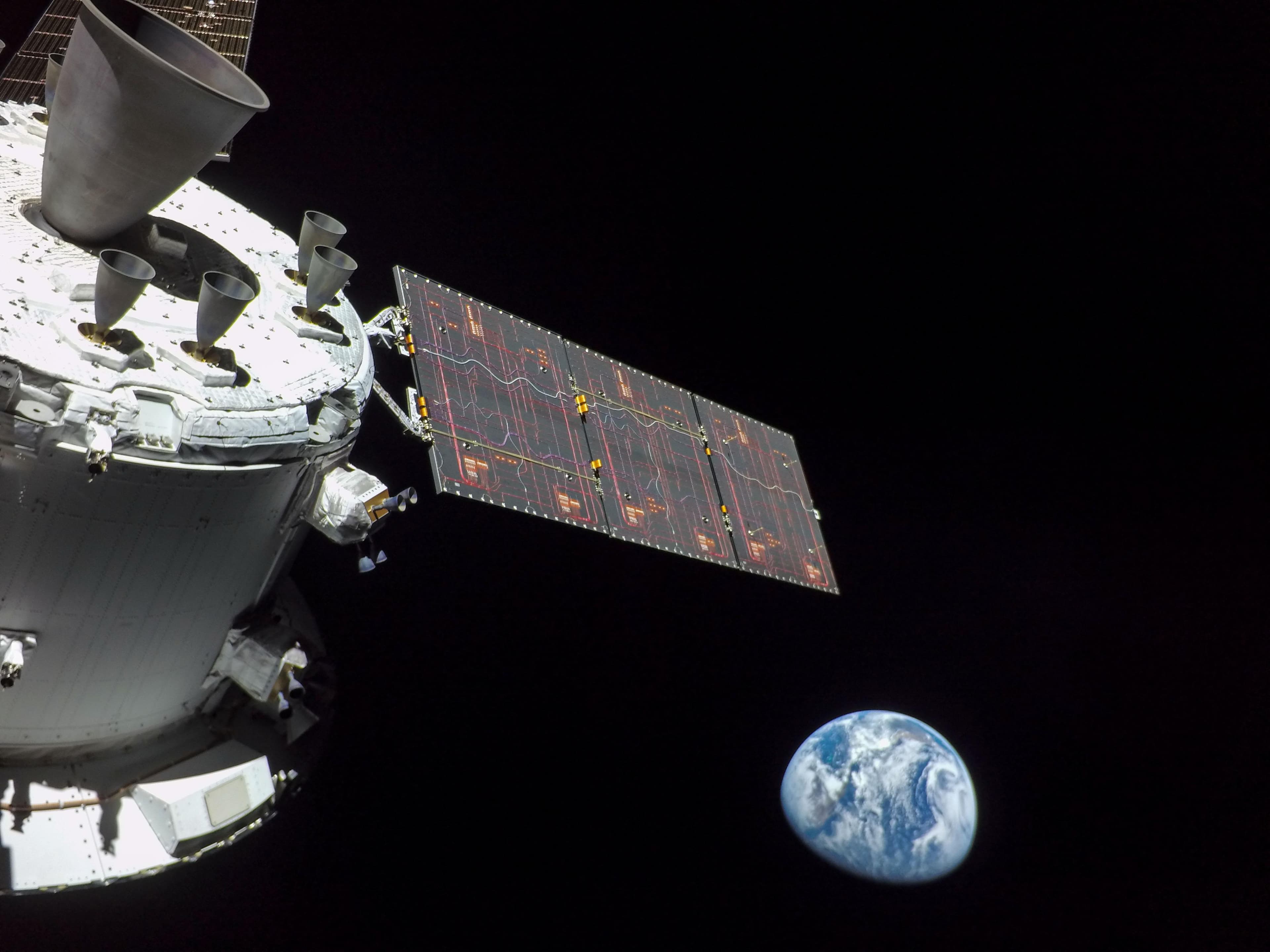
Mission record
Artemis archive entry · Completed
Mission Overview
The mission
Artemis I was the first mission of NASA's Artemis campaign and the first integrated flight of the Space Launch System rocket and Orion spacecraft. The uncrewed mission sent Orion beyond the Moon, placed it into a distant retrograde lunar orbit, and returned the capsule safely to Earth after testing the systems required for future crewed deep-space missions.
Mission Details
Mission Duration
25 days, 10 hours, 53 minutes
Distance Traveled
Approximately 1.4 million miles
Maximum Distance from Earth
Approximately 268,563 miles
Closest Lunar Approach
Approximately 81 miles
Crew
Uncrewed
Launch Vehicle
Space Launch System Block 1
Mission by the Numbers
Mission Statistics
Mission Type
Uncrewed Lunar Flight Test
Launch Vehicle
space-launch-system-block-1
Crew
0 astronauts
Distance Traveled
Approximately 1.4 million miles
Status
Completed
Mission Goals
Mission objectives
- 01
Demonstrate the integrated performance of the Space Launch System rocket and Orion spacecraft
- 02
Test Orion's heat shield during a high-energy lunar-return reentry
- 03
Demonstrate deep-space navigation, communications, propulsion, and power systems
- 04
Operate Orion in a distant retrograde orbit around the Moon
- 05
Recover the Orion crew module after splashdown
- 06
Collect engineering data needed for future crewed Artemis missions
Fascinating Details
Did You Know?
Key did you know? recorded for this mission.
Artemis I carried no astronauts, yet it still flew farther from Earth than any spacecraft ever built to carry humans.
Orion traveled roughly 1.4 million miles during the 25-day mission before splashing down in the Pacific Ocean.
During its outbound flyby, Orion passed within about 81 miles of the lunar surface.
At its farthest point, Orion reached more than 268,000 miles from Earth, a distance record for a human-rated spacecraft.
Orion tested a 'skip entry' during reentry, briefly bouncing off the atmosphere to control heating and improve landing accuracy.
Hydrogen leaks forced NASA to scrub several earlier launch attempts before Artemis I finally lifted off.
The entire uncrewed test flight lasted 25 days, 10 hours, and 53 minutes.
Mission Legacy
Achievements
Key achievements recorded for this mission.
Completed the first integrated flight of SLS and Orion
Sent a human-rated spacecraft farther beyond the Moon than any previous crew-capable spacecraft
Completed approximately 1.4 million miles of travel
Demonstrated Orion's skip-entry technique
Successfully tested Orion's heat shield at lunar-return velocity
Completed a successful Pacific Ocean recovery
Engineering Reality
Challenges
Key challenges recorded for this mission.
Hydrogen leaks delayed several earlier launch attempts
Teams evaluated unexpected behavior in Orion's electrical power system during flight
Post-flight analysis identified heat-shield material behavior requiring additional study
Mission Timeline
November 16, 2022
Launch
Artemis I launched from Launch Complex 39B at Kennedy Space Center aboard the first Space Launch System rocket.
November 16, 2022
Translunar Injection
The Interim Cryogenic Propulsion Stage performed the burn that placed Orion on a trajectory toward the Moon.
November 21, 2022
Outbound Lunar Flyby
Orion passed approximately 81 miles above the lunar surface and used the Moon's gravity to continue toward distant retrograde orbit.
November 25, 2022
Distant Retrograde Orbit
Orion entered a stable distant retrograde orbit around the Moon for extended spacecraft testing.
November 26, 2022
Maximum Distance from Earth
Orion traveled more than 268,000 miles from Earth, setting a distance record for a spacecraft designed to carry humans.
December 5, 2022
Return Lunar Flyby
Orion passed close to the Moon and used a powered flyby to begin its return journey to Earth.
December 11, 2022
Reentry and Splashdown
Orion completed a skip-entry, survived lunar-return heating, and splashed down in the Pacific Ocean.
Mission Hardware
Spacecraft
The launch vehicles, capsules, modules, landers, and other systems assigned to the mission.
Hardware profiles in development
Space Launch System
Launch Vehicle
Orion
Capsule
European Service Module
Service Module
Interim Cryogenic Propulsion Stage
Upper Stage
Related Stories
Apollo
The Moon Photos That Still Feel Impossible
Before social media, astronauts brought back images that changed how humanity saw itself forever.
Read Article →
Artemis
Why Artemis Will Change Lunar Exploration
NASA's return to the Moon is designed to become more sustainable, more international, and more ambitious than Apollo.
Read Article →
ISS
Life 250 Miles Above Earth
Inside the daily routine of astronauts living and working aboard the International Space Station.
Read Article →